
CSR2 Tuning Guide: Nitro, Final Drive, Tires and Shift Timing (2026)
CSR2 Tuning Guide: Nitro, Final Drive, Tires and Shift Timing (2026)
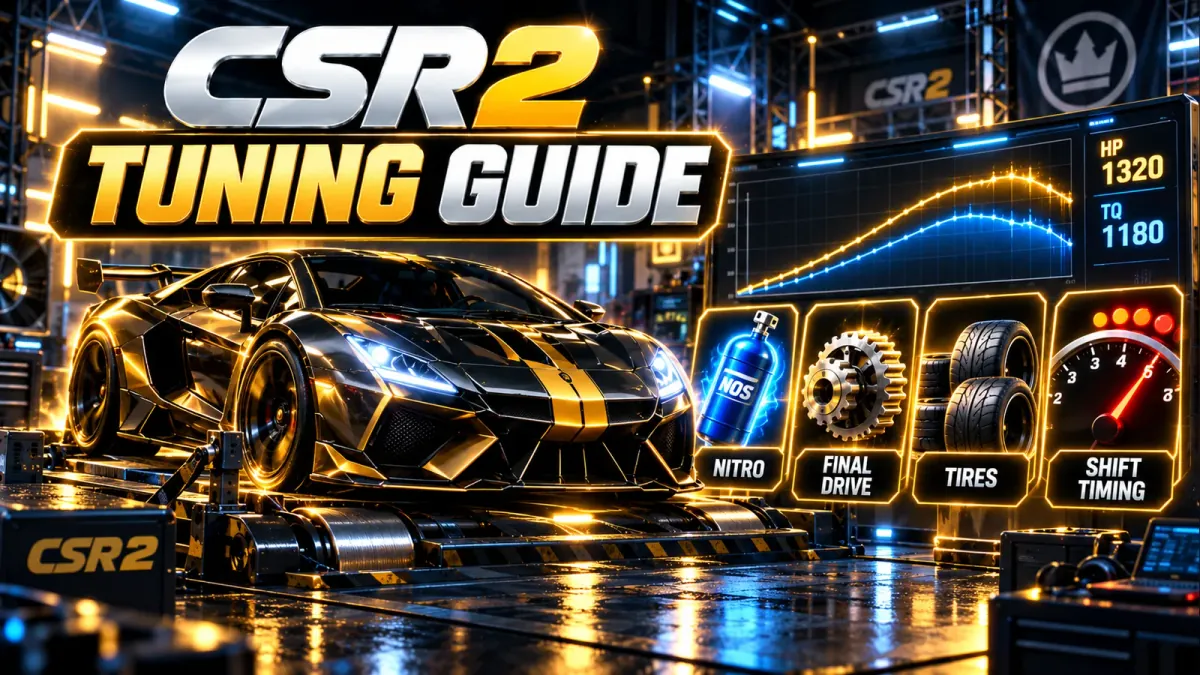
A CSR2 tune is four numbers and a habit. The numbers are nitro duration and PSI, final drive ratio, and front/rear tire balance. The habit is testing every change on the dyno before you touch a real race. Get the habit right and the numbers stop being guesswork, they become a process you repeat on every car you build.
What each setting on a tune line actually does
Every world-record tune you will see published, including the eight examples further down, gets written the same way: nitro as duration over PSI, final drive as a single decimal, and tire as a front/rear percentage split. Here is what each one changes.
- Nitro (duration/PSI). Duration is how long the nitro burns; PSI is how hard it hits. A short, high-PSI nitro (something like 185/4.6) dumps power fast and suits a car that needs a launch boost. A long, low-PSI nitro (363/4.0) spreads the power out for a car that is already strong off the line and needs help holding speed through the back half of the run.
- Final drive. Lower final drive numbers (2.0 to 3.0) favor top speed and suit tracks or cars where you are already gripping fine off the line. Higher numbers (4.5 to 5.0) favor acceleration out of the hole, which matters more on a car that struggles to put power down early.
- Tire balance (front/rear). A 0/100 split puts everything on the rear tires, which is standard for a rear-wheel-drive car trying to maximize launch grip. A near-even split like 52/48 shows up more on all-wheel-drive or front-heavy cars where the front tires are doing real work too.
- EVO. The EVO number is CSR2's raw output score for the engine build, shown alongside PP in your garage. It moves as you invest tune points into the engine's evolution stages, and a higher EVO on an otherwise similar car usually means more of its available upgrade budget has gone into the powertrain specifically.
Why the world-record PP is so much higher than the car's base PP
Look at the table below and you will notice something odd at first glance: the Ford Focus ST Crew starts at a base PP of 167, but the same car's world-record build is closer to double that once nitro, tires and final drive are actually dialed in and upgrades are maxed. That gap is normal, and it is the whole reason "PP" alone is a poor way to judge whether a car will actually be fast. A car's base PP tells you what it starts at in the dealership. Its real ceiling only shows up once someone has pushed the upgrades, the tune, and the EVO investment as far as they go. Two cars with identical base PP can end up several tenths apart at the top end purely because one owner tuned it properly and the other did not.
How to actually test a tune: the dyno and the real run
The dyno screen gives you a predicted time before you spend a single race entry. Change one setting, run the dyno, note the time, change the next setting, run it again. Never change two settings between dyno runs. If you do, you cannot tell which change actually moved the number, and you will end up "tuning by feel" instead of by evidence.
The dyno time and your actual best ET on the strip will not match exactly. Row one in the table below, for example, dynos at 11.722 but has a real best ET of 11.590. The dyno is a controlled prediction; the real run adds your launch timing and shift execution on top of it. A dyno time tells you the tune is good. Your best ET tells you whether you executed it.
Launch and shift timing
Once the tune is set, the two things left in your control are the launch and the shifts. Launch too early off the tree and you red-light; launch too late and you are giving away tenths a good tune already earned back for you. Shifts matter just as much: shift late and you are lugging the engine past its power band, shift early and you never used the RPM range the tune was built around. There is no universal shift point that works across every car, which is exactly why a tune line is only half the story. The other half is spending laps on that specific car until the shift lights stop feeling like a guess.
Eight real world-record tunes, worked as examples
These are actual world-record tune lines pulled straight from car data, not illustrative numbers. Read them against the explanations above: notice how the Tier 1 cars lean toward more balanced tire splits while several Tier 2 cars go all-in on rear grip, and how final drive swings from 2.02 up to 5.00 depending on what each car needed most.
| Tier | Car | PP | Nitro (dur/PSI) | Final Drive | Tire (F/R) | Best ET |
|---|---|---|---|---|---|---|
| 1 | Ford Focus ST Crew (2014) | 167 | 176/4.2 | 2.87 | 52/48 | 11.590 |
| 1 | Volkswagen Golf GTI Crew (1982) | 167 | 245/3.0 | 5.00 | 24/76 | 11.831 |
| 1 | Ford Mustang 302 (1970) | 163 | 188/4.1 | 4.34 | 0/100 | 12.361 |
| 1 | Toyota 86 (2014) | 161 | 205/3.9 | 4.10 | 50/50 | 12.441 |
| 2 | Mini Cooper JCW GP (2020) | 305 | 333/5.1 | 3.87 | 52/48 | 8.409 |
| 2 | Mazda Pande MMX5 (2016) | 304 | 185/4.6 | 2.40 | 0/100 | 8.438 |
| 2 | Porsche 718 Boxster S (2017) | 305 | 266/6.2 | 5.00 | 52/48 | 8.501 |
| 2 | Alpine A110 (2018) | 305 | 363/4.0 | 3.02 | 0/100 | 8.518 |
Every car page in the store lists that car's best available tune the same way, so you can pull one up directly instead of retyping numbers from a screenshot. Check the full CSR2 car collection to find the one you are actually building right now.
FAQ
What is the best CSR2 tune?
There isn't one universal tune. The right setup depends on the car's drivetrain, weight, and power band, which is why the table above shows final drive alone ranging from 2.02 to 5.00 across different cars.
Why doesn't my dyno time match my real race time?
The dyno predicts based on the tune alone. Your real elapsed time also reflects your launch and shift execution, which is why a good tune can still post a slower real ET than its dyno number until you get the shifts right.
Should I copy a world-record tune exactly?
Start there, then adjust. A world-record tune assumes perfect launch and shift execution. If you are consistently short of the listed time, a small final drive adjustment toward more acceleration is usually the first thing worth testing.
Question about this guide?
Message us on Telegram - replies usually within 10 minutes.
Skip the grind
Featured CSR2 packs delivered in 30 min via Telegram.

 499
499

More CSR2 guides
View all
CSR2 Prestige Cup Guide: How It Works and How to Win the Car (2026)
How the CSR2 Prestige Cup actually runs each season: when to pull the car, why timing beats luck, what finishing it pays out, and the strategy that avoids a last-minute scramble.

All Free Cars in CSR2 and How to Get Them (2026)
Real free cars exist in CSR2, from starter picks and season Milestones to Prestige Cup and Legends restorations. Here is every legitimate way to get one, and where the honest paid shortcuts fit in.
CSR2 Mod APK: Why We Do Not Sell One, and What Actually Works (2026)
CSR2 mod apk searches are full of fake downloads. Here is what a modded APK actually is, why it fails against CSR2's server-side economy, and the account-side alternative that works instead.

CSR2 Mods on Android: What Works, What Gets You Banned (2026)
Android is where most CSR2 mod apks get installed because Android allows sideloading. Here is what actually happens when you sideload one, and what works instead.